Authors — Anthony Kaufman
-
The Last Mile

In the battle between big telecoms and tech companies over the issue of net neutrality, independent filmmakers are inevitably going to be collateral damage. While the Federal Communications Commission (FCC) hasn’t yet gone forward with plans to allow Internet Service Providers to charge websites for faster service, the current proposals suggest that challenging times are ahead for media makers and companies who use the Web, with potentially higher costs and increased barriers to entry. As Jamie Wilkinson, CEO of digital distribution platform VHX questions, “As the market gets more crowded, will the prices be driven up?” Without the deep pockets […]
by Anthony Kaufman on Jul 17, 2014 -
Acts of Rebellion: The Dialectical Cinema of Nadav Lapid
In Sergei Eisenstein’s seminal essay “A Dialectic Approach to Film Form,” the Russian filmmaker lays out the foundational theories for his radical political cinema. “Art is always conflict,” he famously writes. “(1) according to its social mission, (2) according to its nature, (3) according to its methodology. According to its social mission because: It is art’s task to make manifest the contradictions of Being.” Israeli auteur Nadav Lapid may not adhere to Eisenstein’s aesthetics of montage, but he appears to be directly influenced by the Russian’s dialectical philosophy of art. Lapid’s astoundingly assured two feature films, 2011’s Policeman (opening this […]
by Anthony Kaufman on Jun 12, 2014 -
Why Too Many Movies Aren’t Necessarily a Problem
There are too many movies, so says The New York Times, Salon.com and The Wrap. And that’s a bad thing. It’s that old law of supply and demand at work, they argue, with an abundance of titles over-saturating the marketplace and sabotaging the sustainability of the art film business. But some distribution professionals respond with a contrary and more nuanced view. There may be a lot of movies being made in the new millennium, but the ever-expanding entertainment universe is here to sort things out. “It’s like saying there are too many books or too many paintings or too much […]
by Anthony Kaufman on Apr 28, 2014 -
Let There Be Natural Light
“Fuck it, I’m going for it.” That, says cinematographer Yves Bélanger, was his response when presented with the challenge of shooting Dallas Buyers Club using only natural light. But aided by the ALEXA digital camera and his freewheeling director Jean-Marc Vallée, Bélanger handily shot the entire film without the heavy equipment usually associated with movies starring the likes of Matthew McConaughey and Jennifer Garner. No tripods, no lighting kits. His only artificial source of illumination: a small Kino Flo he used at the beginning of each day to shoot his color charts to make sure the color balance was correct. […]
by Anthony Kaufman on Apr 28, 2014 -
Hits & Misses
By the end of 2013, the most pressing question facing Hollywood was already old news for indies: multiplatform viewing is here, and particularly for independents, it’s here to stay. A significant source of revenue, in most cases, and a crucial method of finding an audience, the iTunes-Cable VOD and direct-to-consumer release has increasingly become an integral, if not principal, part of filmmakers’ distribution strategies. And yet, the irony of the past year in indie film is that much of the business was reliant on that hoary, old-fashioned, windowed release. For every VOD breakout surprise such as Drinking Buddies or Only […]
by Anthony Kaufman on Jan 17, 2014 -
Bad Metrics
Even if you don’t know baseball, you probably know the term “batting average” (or BA), which is widely used as the best measure of a batter’s prowess. Defined as the number of hits divided by the number of times at bat, it’s reported as a decimal number (i.e., .300 refers to the praiseworthy remark “batting 300”). The three all-time BA leaders are Ty Cobb (.366), Roger Hornsby (.358) and Joe Jackson (.356). But some baseball insiders have criticized the metric because it doesn’t account for the quality of those “at bats.” For many, it’s a shortsighted statistic that elides the […]
by Anthony Kaufman on Oct 21, 2013 -
“In the Same Way Painters Used Their Paint…”: D.P. Bradford Young on Ain’t Them Bodies Saints and Mother of George
In just a few years, Bradford Young has emerged as one of the most auspicious and distinctive cinematographers in American independent film. First noticed in 2011 for his work on Andrew Dosunmu’s Restless City and Dee Rees’ Pariah, he was profiled by the New York Times the following year for his subtle, carefully framed cinematography on Ava DuVernay’s Middle of Nowhere. In just the past year, Young confirmed his early promise with two sumptuous and yet highly disparate visions: for David Lowery’s Texas-set period film Ain’t Them Bodies Saints (opening this week) and Dosunmu’s Brooklyn-based contemporary drama Mother of George […]
by Anthony Kaufman on Aug 14, 2013 -
A Business of Ignorance?
The impact of digital distribution on the indie film landscape has been vast. First, film titles began to inch up the alphabet toward the letter “A” to get noticed at the top of VOD listings. The latest development: Find a young TV star with a solid online fan base and you’re gold. “I’m seeing more and more films leveraging up-and-coming TV actors that have social media profiles,” says Erick Opeka, senior vice president of digital distribution at Cinedigm Entertainment. “Those audiences can’t wait to consume more product that features their favorite actors. The films come out of nowhere and storm […]
by Anthony Kaufman on Jul 18, 2013 -
Medium Specific: An Interview with Computer Chess Director Andrew Bujalski
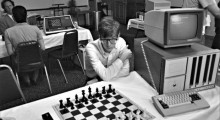
Andrew Bujalski’s Computer Chess is the most daring feature film of the year. A bewildering and baffling trip back in time (to circa 1980), the movies follows a group of four-eyed super-nerds engaged in a unique chess tournament – in which their carefully designed computer programs face off against each other. Shot on 43-year-old video equipment (the Sony AVC3260, one of the earliest consumer cameras), the movie looks like a lost artifact from another era — with soupy black-and-white images that take on a ghostly pallor. If Bujalski is known for his lo-fi minimalist human comedies Funny Ha Ha, Mutual […]
by Anthony Kaufman on Jul 15, 2013 -
The Invisible Filmmakers
Black films don’t travel. It’s one of the oldest clichés in the movie business. And it may be as true today as it was 20 years ago when producer Andrew Vajna famously declared, “There are no black actors today [who] mean anything to the foreign marketplace.” Hollywood may have made some headway in overcoming the racial road-blocks that exist in overseas markets; the foreign box-office for Quentin Tarantino’s Jamie Foxx-starring Django Unchained, for example, has well surpassed domestic sales, as did, surprisingly, Martin Lawrence’s 2011 comedy Big Mommas: Like Father, Like Son. But those films remain the exception, not the […]
by Anthony Kaufman on Apr 23, 2013