• Skip to primary navigation
  • Skip to main content
  • Skip to primary sidebar
  • Skip to footer

The College Investor

Student Loans, Investing, Building Wealth

  • About
  • Podcasts
  • Research
  • Contact
  • Save For College
      • How To Start

      • How To Save For College
      • How To Pay For College
      • What Is the Average Cost of College?
      • What Is A 529 Plan and Where to Open One in Your State
      • How Much Should You Have In A 529 Plan By Age
      • How To Use A 529 Plan For Private Elementary And High School
      • What Are Qualified Expenses For A 529 Plan (And What Doesn’t Count)?
      • The Best Brokers To Open A 529 Plan
      • Tools + Accounts

      • 529 Plans: The Ultimate College Savings Plan
      • 529 Plan Contribution Limits For 2024
      • Prepaid Tuition Plans | What To Know
      • Understanding And Using 529A ABLE Accounts
      • Using A Roth IRA To Save And Pay For College
      • FAFSA Deadlines for Financial Aid
      • CollegeBacker Review
      • Upromise Review
      • UNest Review
      • Other Options

      • Student Loan And Financial Aid Programs By State
      • The Guide To Military And VA Education Benefits
      • How To Fill Out The FAFSA
      • How To Find College Scholarships
      • The Best College Scholarship Search Websites
      • How To Find Grants To Pay For College
      • Pell Grants: What They Are And How To Qualify
      • Understanding Federal Work-Study
      • How To Use A 529 Plan If Your Child Doesn’t Go To College
  • Student Loans
      • Borrowing

        • How Student Loans Work
        • How To Apply For A Student Loan
        • Best Student Loans And Rates In January 2024
        • 10 Best Private Student Loans Of January 2024
        • Best Student Loans To Pay For Graduate School
        • Best Student Loans For Medical School
        • Parent Loans To Pay For College
        • No-Cosigner Student Loan Options
        • Guide To Income Sharing Agreements (ISAs)
        • Best International Student Loans
      • Get Out Of Debt

        • Best Student Loan Refinance Companies In January 2024
        • Best Student Loan Repayment Plans
        • Best Student Loan Refinancing Bonuses And Promotional Offers Of January 2024
        • Student Loan Forgiveness Programs (The Complete List)
        • The Full List Of Student Loan Forgiveness Programs By State
        • Public Service Loan Forgiveness (PSLF)
        • Top Student Loan Scams
        • Average Student Loan Monthly Payment
        • Average Student Loan Debt By Year
      • Reviews

        • Credible Review
        • Splash Review
        • Ascent Review
        • Citizens Bank Review
        • Earnest Review
        • ELFI Review
        • Laurel Road Review
        • LendKey Review
        • SoFi Review
        • Sallie Mae Review
  • Investing
      • How To Start

        • How To Start Investing in High School
        • How To Start Investing In College
        • How To Start Investing In Your Twenties For 22 – 29 Year Olds
        • How To Start Investing In Your 30s For 30 – 39 Year Olds
        • How To Start Investing With $100 Or Less
        • How To Give Kids The Gift Of Stock
        • What Is Dividend Growth Investing
        • IRA Rollover Chart
      • Tools + Accounts

        • Best Online Stock Brokers
        • The Best Traditional And Roth IRA Accounts
        • The Best Robo-Advisors
        • The Best Investing Apps
        • The Best Places to Trade Options
        • The Best Places To Open A Health Savings Account
        • The Best Solo 401k Providers
        • The Best Self-Directed IRA Providers Of 2024
        • Best Cryptocurrency Exchanges
      • Reviews

        • Vanguard Review
        • Fidelity Review 2024: Pros, Cons, Account Types, and More
        • M1 Finance Review
        • TD Ameritrade Review 2024: Now Part Of Schwab
        • Charles Schwab Review
        • Robinhood Review
        • Webull Review
        • Betterment Review 2024: One Of The First Robo-Advisors
        • Wealthfront Review
  • Earn More Money
      • Extra Income

        • 20 Best Side Hustles You Can Start Earning With In 2024
        • 54 Side Hustle Ideas To Make Money Fast In 2024
        • 100 Ways To Make Money In College In 2024
        • How To Make Money From Home: 80 Irresistible Ideas
        • How To Make Money In One Hour: 5 Quick Ideas You Can Try Now
        • 10 Interesting Ways You Can Make Money Driving
        • High-Paying Side Gigs That Earn $1,000 or More Per Month
        • The 10 Best Money-Making Apps
        • Best Paid Survey Site List: Earn Money For Giving Your Opinion Online
        • 10 Crazy Ways To Make $10,000 You’ve Never Heard Of
      • Build Wealth

        • 30 Passive Income Ideas For 2024 To Build Real Wealth
        • 3 Ways To Make $50,000 Per Year Without Working With Passive Income
        • How To Become A Real Estate Investor With Just $500
        • 15 Best Online Business Ideas
        • Residual Income: 7 Super Smart Ways to Build It
        • The Most Common Multiple Income Streams
        • How To Become A Real Estate Mogul With Only $10,000
      • Reviews

        • Fundrise Review
        • RealtyMogul Review
        • FarmTogether Review
        • AcreTrader Review
        • Swagbucks Review
        • Survey Junkie Review
        • TopCashback Review: Earn Cash For Online Shopping
        • DoorDash Review
  • Personal Finance
      • Banking

        • Best High Yield Savings Accounts Of January 2024
        • 10 Best Money Market Accounts Of January 2024
        • 10 Best Free Checking Accounts In January 2024
        • Best Bank CD Rates Of January 2024
        • 10 Best Business Checking Accounts In January 2024
        • Best Online Banks Of January 2024
        • Best Credit Unions Nationwide Of January 2024
        • Best College Student Checking Accounts Of January 2024
      • Insurance

        • Best Life Insurance Companies
        • Renters Insurance
        • Car Insurance
        • Pet Insurance
        • Umbrella Insurance
        • Disability Insurance
        • Tuition Insurance
        • Travel Insurance
      • Credit Tools

        • Best Budgeting Apps
        • Cash Advance Apps
        • How To Get A Free Credit Score Report
        • Best Credit Monitoring Services For 2024
        • Debt Settlement: Inside The Secret World
        • Credit Repair Explained: Should You Pay For Help?
        • Best Personal Loan Companies And Lenders
        • Online Loan Companies To Borrow From Home
      • Tax

        • Best Tax Software
        • Free Tax Software
        • IRS Tax Refund Calendar
        • Common IRS Questions and Errors
        • Federal Tax Brackets
        • Capital Gains Tax Brackets
        • 401k Contribution Limits
        • IRA Contribution Limits
        • HSA Contribution Limits
  • Awards
  • Search
Home / Taxes / Forms / What Is Schedule D? How To Report Capital Gains And Losses

What Is Schedule D? How To Report Capital Gains And Losses

Updated: September 14, 2023 By Robert Farrington

  • Facebook
  • X (Twitter)
  • LinkedIn
  • Pinterest
  • Email
  • Print

At The College Investor, we want to help you navigate your finances. To do this, many or all of the products featured here may be from our partners who compensate us. This doesn't influence our evaluations or reviews. Our opinions are our own. Any investing information provided on this page is for educational purposes only. The College Investor does not offer investment advisor or brokerage services, nor does it recommend buying or selling particular stocks, securities, or other investments. Learn more here.Advertiser Disclosure

There are thousands of financial products and services out there, and we believe in helping you understand which is best for you, how it works, and will it actually help you achieve your financial goals. We're proud of our content and guidance, and the information we provide is objective, independent, and free.

But we do have to make money to pay our team and keep this website running! Our partners compensate us. TheCollegeInvestor.com has an advertising relationship with some or all of the offers included on this page, which may impact how, where, and in what order products and services may appear. The College Investor does not include all companies or offers available in the marketplace. And our partners can never pay us to guarantee favorable reviews (or even pay for a review of their product to begin with).

For more information and a complete list of our advertising partners, please check out our full Advertising Disclosure. TheCollegeInvestor.com strives to keep its information accurate and up to date. The information in our reviews could be different from what you find when visiting a financial institution, service provider or a specific product's website. All products and services are presented without warranty.

Schedule D

If you have capital gains or losses (from selling stock, options, or crypto), or you had proceeds from the sale of your home, you're going to be using Schedule D for your taxes. But you may have never heard of it before.

For most people, their tax software or accountant will help with this form. But you may have questions about how it works, where to find it, or even what your tax implication may be.

Let's break down exactly what the Schedule D is, and how you should use it.

Table of Contents
Schedule D Basics
Format of Schedule D
Form 8949
Declaring Losses
Filing Your Taxes

Schedule D Basics

Schedule D is used to report income or losses from capital assets. Assets owned by you are considered capital assets. These include your home, car, boat, furniture, and stocks, to name a few. There is a lengthy list of items that are not capital assets, which you can see on page D-2 of the Schedule D instructions.

Schedule D is where you list the total of asset proceeds with their cost bases. The cost bases are derived from specific asset entries on Form 8949, which was new for the year 2011. Schedule D was updated to accommodate Form 8949.

Cost basis can be calculated based on FIFO (first in, first out), average, or something specific you tell your broker. You can do this by sending a letter to your broker, letting them know how you’d like the cost basis calculated.

For example, you want to minimize your gain. You can do that by selling shares with the highest cost basis. FIFO is the IRS “default” method. It also yields the highest taxes. The average cost method is in between the FIFO and specific cost basis methods.

The average cost method is the simplest method for determining the cost basis. You might pay a little more in taxes when using this method but it will also save you time in having to do any tedious calculations. Note that you do not need to calculate a cost basis for assets in a retirement account.

Capital gains are not just about stocks. If you sell your home for more than you paid for it, you’ll have capital gains. When you sell your home, you’ll need to report it on Form 2119 (Sale of Your Home).

If the home is your primary residence, you can take advantage of a 121 exclusion and avoid capital gains. As you might expect, there are some rules that must be met to take advantage of a 121 exclusion. In the five years prior to the sale of the home, you must have lived in it for an aggregate of at least two years. A 121 exclusion allows you to exclude up to $250,000 in gains as an individual and $500,000 for joint filers.

As an example, you bought a house for $200,000 and five years later sold it for $300,000, resulting in a $100,000 gain. You lived in the house for two years during those five years. The $100,000 gain can be excluded from your income.

If you rented the home during those five years, things get more complicated and the exclusion may not apply. Additionally, you must meet the use and ownership test. You’ll want to speak with your accountant for clarification.

Let’s look more closely at the format of Schedule D.
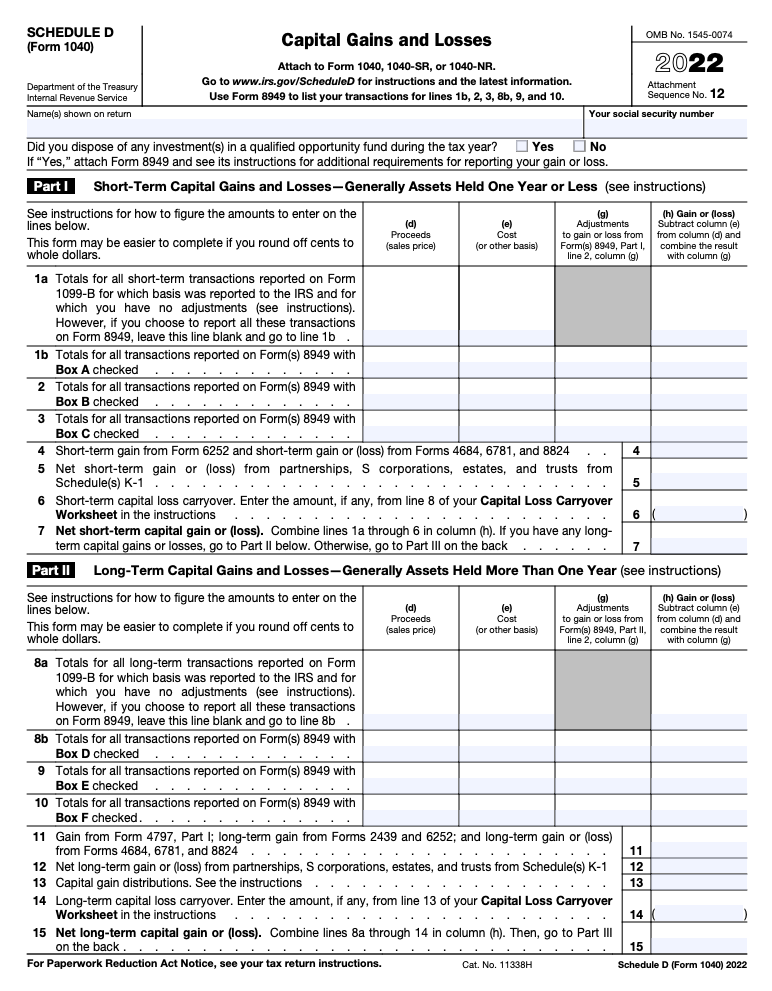
IRS Form Schedule D

Format of Schedule D

IRS Schedule D (1040) is broken up into three main parts, with each being labeled. The first part is for short-term gains and losses, which are those held for one year or less. The second part is for long-term gains or losses, which are held for more than one year. The final section is the summary.

Short-term gains are taxed at your ordinary income tax rate. Long-term gains are taxed at 0%, 15%, and 20%, depending on your income. A higher income will, of course, result in more taxes. The 0% rate applies to those making $0–$39,375 for single filers and $0–$78,750 for those who are married, filing jointly.

You can learn more about the capital gains tax brackets here >>

Form 8949

As mentioned above, Form 8949 contains individual entries for each capital gain or loss. If you received any 1099s (1099-B or 1099-DIV), your capital gains or losses should already be reported to the IRS. In that case, you do not need to fill out Form 8949.

Form 1099-B comes from your broker. Form 1099-DIV is for dividends from savings accounts, mutual funds, or other sources.

Declaring Losses

You can declare up to $3,000 in losses ($1,500 for married, filing separately) on Schedule D, line 21.

If you have more than $3,000 in losses, the remainder can be carried forward for future years. For example, let’s say your stock trading for the year resulted in $5,000 of losses. $3,000 can be reported on Schedule D and $2,000 can be carried forward. The $2,000 loss will be applied the next year to offset income.

After Schedule D has been completed, its results are transferred to Form 1040. The results of Schedule D will impact adjusted gross income on Form 1040. Just like many of the other related 1040 forms, it’s important to get your cost basis and any losses right so that your income is reduced and you don’t end up paying taxes on phantom income.

Filing Your Taxes

Unless you're filing your taxes by hand, you don't really need to know the intricacies of the Schedule D. Your tax software program, or accountant, will handle the details of filing this form in.

However, it's important to realize that having capital gains and losses will likely push up the costs of doing your taxes - you'll either need a premium tax software or you'll pay your tax preparer more.

Check out our guide to the best tax software for investors here >>

Robert Farrington
Robert Farrington

Robert Farrington is America’s Millennial Money Expert® and America’s Student Loan Debt Expert™, and the founder of The College Investor, a personal finance site dedicated to helping millennials escape student loan debt to start investing and building wealth for the future. You can learn more about him on the About Page or on his personal site RobertFarrington.com.

He regularly writes about investing, student loan debt, and general personal finance topics geared toward anyone wanting to earn more, get out of debt, and start building wealth for the future.

He has been quoted in major publications, including the New York Times, Wall Street Journal, Washington Post, ABC, NBC, Today, and more. He is also a regular contributor to Forbes.

Editor: Clint Proctor Reviewed by: Claire Tak
Schedule D
Editorial Disclaimer: Opinions expressed here are author’s alone, not those of any bank, credit card issuer, airlines or hotel chain, or other advertiser and have not been reviewed, approved or otherwise endorsed by any of these entities.
Comment Policy: We invite readers to respond with questions or comments. Comments may be held for moderation and are subject to approval. Comments are solely the opinions of their authors'. The responses in the comments below are not provided or commissioned by any advertiser. Responses have not been reviewed, approved or otherwise endorsed by any company. It is not anyone's responsibility to ensure all posts and/or questions are answered.
Subscribe
Connect with
I allow to create an account
When you login first time using a Social Login button, we collect your account public profile information shared by Social Login provider, based on your privacy settings. We also get your email address to automatically create an account for you in our website. Once your account is created, you'll be logged-in to this account.
DisagreeAgree
Notify of

I allow to create an account
When you login first time using a Social Login button, we collect your account public profile information shared by Social Login provider, based on your privacy settings. We also get your email address to automatically create an account for you in our website. Once your account is created, you'll be logged-in to this account.
DisagreeAgree

0 Comments
Inline Feedbacks
View all comments

Primary Sidebar

Tax Resources

Featured Tax Reviews

>  H&R Block (recommended)
>  FreeTaxUSA (recommended)
>  Cash App Taxes  (recommended)
>  TurboTax
>  TaxSlayer
>  TaxAct

Tax Software

  • Best Tax Software 2024 [Awards]
  • Free Tax Software 2023
  • Best Crypto And NFT Tax Software For 2023

Tax Brackets

  • Federal Tax Income Brackets
  • Capital Gains Tax Brackets

More on Taxes

  • When To Expect My Tax Refund? The IRS Tax Refund Calendar 2024
  • Common IRS Where’s My Refund Questions and Errors
  • IRS Where’s My Refund Reference Codes
  • TurboTax, H&R Block, TaxAct, And TaxSlayer Pricing Comparison
  • Best Tax Software For Students (And Student Loans)
  • The Most Common Tax Deductions
  • Stopping Tax Offsets Due To Student Loan Debt
  • Tax Resource And Help Center

Footer

Who We Are

The College Investor is an independent, advertising-supported financial media publisher, focusing on news, product reviews, and comparisons.

Connect

  • Contact Us
  • Advertise
  • Press & Media

About

  • About
  • Our Team
  • Podcast
  • Editorial Guidelines
  • How We Make Money
  • Archives

Social

Copyright © 2024 · The College Investor · Privacy Policy ·Terms of Service · DO NOT Sell My Personal Information

wpDiscuz