
• Skip to primary navigation
  • Skip to main content
  • Skip to primary sidebar
  • Skip to footer

The College Investor

Student Loans, Investing, Building Wealth

  • About
  • Podcasts
  • Research
  • Contact
  • Save For College
      • How To Start

      • How To Save For College
      • How To Pay For College
      • What Is the Average Cost of College?
      • What Is A 529 Plan and Where to Open One in Your State
      • How Much Should You Have In A 529 Plan By Age
      • How To Use A 529 Plan For Private Elementary And High School
      • What Are Qualified Expenses For A 529 Plan (And What Doesn’t Count)?
      • The Best Brokers To Open A 529 Plan
      • Tools + Accounts

      • 529 Plans: The Ultimate College Savings Plan
      • 529 Plan Contribution Limits For 2024
      • Prepaid Tuition Plans | What To Know
      • Understanding And Using 529A ABLE Accounts
      • Using A Roth IRA To Save And Pay For College
      • FAFSA Deadlines for Financial Aid
      • CollegeBacker Review
      • Upromise Review
      • UNest Review
      • Other Options

      • Student Loan And Financial Aid Programs By State
      • The Guide To Military And VA Education Benefits
      • How To Fill Out The FAFSA
      • How To Find College Scholarships
      • The Best College Scholarship Search Websites
      • How To Find Grants To Pay For College
      • Pell Grants: What They Are And How To Qualify
      • Understanding Federal Work-Study
      • How To Use A 529 Plan If Your Child Doesn’t Go To College
  • Student Loans
      • Borrowing

        • How Student Loans Work
        • How To Apply For A Student Loan
        • Best Student Loans And Rates In January 2024
        • 10 Best Private Student Loans Of January 2024
        • Best Student Loans To Pay For Graduate School
        • Best Student Loans For Medical School
        • Parent Loans To Pay For College
        • No-Cosigner Student Loan Options
        • Guide To Income Sharing Agreements (ISAs)
        • Best International Student Loans
      • Get Out Of Debt

        • Best Student Loan Refinance Companies In January 2024
        • Best Student Loan Repayment Plans
        • Best Student Loan Refinancing Bonuses And Promotional Offers Of January 2024
        • Student Loan Forgiveness Programs (The Complete List)
        • The Full List Of Student Loan Forgiveness Programs By State
        • Public Service Loan Forgiveness (PSLF)
        • Top Student Loan Scams
        • Average Student Loan Monthly Payment
        • Average Student Loan Debt By Year
      • Reviews

        • Credible Review
        • Splash Review
        • Ascent Review
        • Citizens Bank Review
        • Earnest Review
        • ELFI Review
        • Laurel Road Review
        • LendKey Review
        • SoFi Review
        • Sallie Mae Review
  • Investing
      • How To Start

        • How To Start Investing in High School
        • How To Start Investing In College
        • How To Start Investing In Your Twenties For 22 – 29 Year Olds
        • How To Start Investing In Your 30s For 30 – 39 Year Olds
        • How To Start Investing With $100 Or Less
        • How To Give Kids The Gift Of Stock
        • What Is Dividend Growth Investing
        • IRA Rollover Chart
      • Tools + Accounts

        • Best Online Stock Brokers
        • The Best Traditional And Roth IRA Accounts
        • The Best Robo-Advisors
        • The Best Investing Apps
        • The Best Places to Trade Options
        • The Best Places To Open A Health Savings Account
        • The Best Solo 401k Providers
        • The Best Self-Directed IRA Providers Of 2024
        • Best Cryptocurrency Exchanges
      • Reviews

        • Vanguard Review
        • Fidelity Review 2024: Pros, Cons, Account Types, and More
        • M1 Finance Review
        • TD Ameritrade Review 2024: Now Part Of Schwab
        • Charles Schwab Review
        • Robinhood Review
        • Webull Review
        • Betterment Review 2024: One Of The First Robo-Advisors
        • Wealthfront Review
  • Earn More Money
      • Extra Income

        • 20 Best Side Hustles You Can Start Earning With In 2024
        • 54 Side Hustle Ideas To Make Money Fast In 2024
        • 100 Ways To Make Money In College In 2024
        • How To Make Money From Home: 80 Irresistible Ideas
        • How To Make Money In One Hour: 5 Quick Ideas You Can Try Now
        • 10 Interesting Ways You Can Make Money Driving
        • High-Paying Side Gigs That Earn $1,000 or More Per Month
        • The 10 Best Money-Making Apps
        • Best Paid Survey Site List: Earn Money For Giving Your Opinion Online
        • 10 Crazy Ways To Make $10,000 You’ve Never Heard Of
      • Build Wealth

        • 30 Passive Income Ideas For 2024 To Build Real Wealth
        • 3 Ways To Make $50,000 Per Year Without Working With Passive Income
        • How To Become A Real Estate Investor With Just $500
        • 15 Best Online Business Ideas
        • Residual Income: 7 Super Smart Ways to Build It
        • The Most Common Multiple Income Streams
        • How To Become A Real Estate Mogul With Only $10,000
      • Reviews

        • Fundrise Review
        • RealtyMogul Review
        • FarmTogether Review
        • AcreTrader Review
        • Swagbucks Review
        • Survey Junkie Review
        • TopCashback Review: Earn Cash For Online Shopping
        • DoorDash Review
  • Personal Finance
      • Banking

        • Best High Yield Savings Accounts Of January 2024
        • 10 Best Money Market Accounts Of January 2024
        • 10 Best Free Checking Accounts In January 2024
        • Best Bank CD Rates Of January 2024
        • 10 Best Business Checking Accounts In January 2024
        • Best Online Banks Of January 2024
        • Best Credit Unions Nationwide Of January 2024
        • Best College Student Checking Accounts Of January 2024
      • Insurance

        • Best Life Insurance Companies
        • Renters Insurance
        • Car Insurance
        • Pet Insurance
        • Umbrella Insurance
        • Disability Insurance
        • Tuition Insurance
        • Travel Insurance
      • Credit Tools

        • Best Budgeting Apps
        • Cash Advance Apps
        • How To Get A Free Credit Score Report
        • Best Credit Monitoring Services For 2024
        • Debt Settlement: Inside The Secret World
        • Credit Repair Explained: Should You Pay For Help?
        • Best Personal Loan Companies And Lenders
        • Online Loan Companies To Borrow From Home
      • Tax

        • Best Tax Software
        • Free Tax Software
        • IRS Tax Refund Calendar
        • Common IRS Questions and Errors
        • Federal Tax Brackets
        • Capital Gains Tax Brackets
        • 401k Contribution Limits
        • IRA Contribution Limits
        • HSA Contribution Limits
  • Awards
  • Search
Home / Investing / Real Estate / Groundfloor Review: Crowdfunded Real Estate Lending

Groundfloor Review: Crowdfunded Real Estate Lending

Updated: August 8, 2023 By Robert Farrington

  • Facebook
  • X (Twitter)
  • LinkedIn
  • Pinterest
  • Email
  • Print

At The College Investor, we want to help you navigate your finances. To do this, many or all of the products featured here may be from our partners who compensate us. This doesn't influence our evaluations or reviews. Our opinions are our own. Any investing information provided on this page is for educational purposes only. The College Investor does not offer investment advisor or brokerage services, nor does it recommend buying or selling particular stocks, securities, or other investments. Learn more here.Advertiser Disclosure

There are thousands of financial products and services out there, and we believe in helping you understand which is best for you, how it works, and will it actually help you achieve your financial goals. We're proud of our content and guidance, and the information we provide is objective, independent, and free.

But we do have to make money to pay our team and keep this website running! Our partners compensate us. TheCollegeInvestor.com has an advertising relationship with some or all of the offers included on this page, which may impact how, where, and in what order products and services may appear. The College Investor does not include all companies or offers available in the marketplace. And our partners can never pay us to guarantee favorable reviews (or even pay for a review of their product to begin with).

For more information and a complete list of our advertising partners, please check out our full Advertising Disclosure. TheCollegeInvestor.com strives to keep its information accurate and up to date. The information in our reviews could be different from what you find when visiting a financial institution, service provider or a specific product's website. All products and services are presented without warranty.

Groundfloor Review

Are you looking to boost your portfolio returns through crowdfunding - especially real estate focused? For the last several years Lending Club and Prosper have allowed everyday investors to profit from consumer lending.

But in the last few years, a new type of real estate investing platform registered with the SEC. Groundfloor  is the first company qualified by the SEC to offer real estate debt investments via Regulation A for non-accredited investors.

So far, Groundfloor has lent out $500 million across 2,600+ projects. Investors to date have received average returns of 10% with a loss ratio (the ratio of principal lost to total principal invested) of less than 1% since 2013.

The numbers sound enticing, but is Groundfloor right for you? Here’s what you need to know in our Groundfloor review.


Groundfloor

Quick Summary

  • Investment lending and borrowing platform for real estate
  • Focus is on fix and flip properties
  • Short-term investing with Groundfloor Notes
  • You can invest within a self-directed IRA
OPEN AN ACCOUNT

Groundfloor Details

Product Name

Groundfloor

Min Investment

$10

Annual Fee

None for Investors

Account Type

Cash and SDIRA

Promotions

None

Table of Contents
What Is Groundfloor?
How Groundfloor LROs Work
Groundfloor Offers Broad Exposure Potential
Introducing Groundfloor Notes
Who Shouldn’t Use Groundfloor?
How Does Groundfloor Compare?
Who Can Profit From Groundfloor?

What Is Groundfloor?

Groundfloor is a crowdfunded real estate lending and investing platform. As an investor, you can preview and fund loans for residential real estate projects, including Fix and Flip properties, new construction properties, and buy-and-hold properties.

Potential borrowers submit a loan package that includes detailed numbers, pictures of the property and more. The Groundfloor team of experts reviews proposals, and then chooses to allow the loan into the pipeline or not. The SEC then qualifies each loan as an investment security called a Limited Recourse Obligation (LRO), which is then put on the Groundfloor platform for funding.

Once the deal is in the pipeline, investors can begin allocating funds to the loan. Usually the loan is for a term of 6-12 months, but it could be shorter or longer. When the money is in the loan, it’s not liquid. You can’t sell it to another investor, and you can’t cash it out. Once the principal is returned, you’ll receive a repayment of your investment, plus the predetermined interest. You’ll have the option to invest again or withdraw the cash to your bank account.

Groundfloor works with investors nationwide. They work with borrowers in 32 states.

Groundfloor lending map

Borrowers can get loans for $75K - $1 Million at rates as low as 5.5%. Anyone who has worked with a hard money lender knows that these are screaming deals. They will fund up to 100% of the cost of a project for qualified borrowers, and up to 70% of the after flip value. Groundfloor also offers a unique deferred payment loan option, which means you will have no payments during the term of the loan.

How Groundfloor LROs Work

Many investors who will never pick up a hammer, talk to a home inspector, or rehab a house want access to Real Estate investments within their portfolio. Most of these investors will gain real estate exposure by purchasing REITs.

Groundfloor isn’t a REIT. It’s a lending marketplace. The Groundfloor Team is loaded with Real Estate Experts, with over 100 years of collective real estate experience, but there are no guarantees with Groundfloor LROs.

As mentioned, LROs are secured debt investments that provide a share of the interest and principal payments on a specific real estate loan. If you invest in a loan, and the loan goes into default and experiences a loss, you could lose your investment. However, it’s important to note that loans in default don’t always (or even usually) result in a loss. 

According to Groundfloor’s recent analysis, loans that have gone into default have still historically returned over 8% interest on average. Groundfloor is always in first lien position on the home. So some or all of the principal can be returned to you in the event of a loss as well.

Since launching in 2013, Groundfloor’s loss ratio (the ratio of principal lost to principal invested) has been less than 1%. If a loan experiences a loss, it could be the loan you fund. As an investor, you don’t have control over the project. You’re outsourcing that work to others.

The key to successful investing on Groundfloor is diversification. Investors who have diversified their portfolios into a large number of loans can still realize high overall rates of return, even when losses occur. In fact, Groundfloor's analysis shows that a model portfolio consisting of an equal investment made into all 1,545 loans repaid as of July 2021 would've earned an annualized net return of 9.98%. It’s a great concept, and Groundfloor now has over eight years of data that you can review in the many analyses the company has available on its blog.

However, it’s a good idea to take some time to become comfortable with Groundfloor’s model before you commit money. Luckily, the company’s $10 minimum investment size allows you to try the platform out and get a feel for how it works first, without having to invest large sums.

Groundfloor Offers Broad Exposure Potential

Groundfloor doesn’t require you to fund an entire loan yourself. That’s a good thing because the loans are between $75k-$1M. You can gain exposure to loans in up to 32 states. Transparent deals in diverse geographic regions can give you a margin of safety.

A common maxim in real estate is “All Real Estate is Local.” It’s true, but that doesn’t mean that you need all your real estate in one location. To invest through Groundfloor you don’t have to be super-knowledgeable about one particular real estate market. Instead, you can diversify your lending into a number of loans spread across different borrowers in different geographic regions.

The opportunity for diversification across a growing number of high quality loans is one of Groundfloor's biggest strengths. Their $10 minimum investment per project is an intentionally low barrier to diversification, allowing you to easily diversify your portfolio across many projects if you so choose. But as an investor, you need to be mindful about maintaining diversification. Don’t go all in on a single loan unless you’re willing to lose all your money on a single loan.

Remember, make sure you understand all the risks of crowdfunding platforms.

Introducing Groundfloor Notes

Groundfloor recently opened up access to a new product, Groundfloor Notes, which aims to provide investors with real returns and short-term liquidity. Groundfloor Notes are debt investments that provide a fixed interest rate for a fixed term. According to Groundfloor, Notes combine the benefits of savings and investing into a single convenient investment experience. 

Groundfloor Notes are secured by pools of loans that Groundfloor has originated, but not yet funded as LROs. The shorter holding periods and fixed repayment dates mean that Notes have a lower risk profile than Groundfloor LROs. 

Each Groundfloor Note offers different term lengths, interest rates, and investment minimums, and Groundfloor releases new Note options each month. For example, at the time of writing, Groundfloor is offering interest rates between 4% and 10% on Notes with terms ranging from 30 days to 12 months. 

When Notes was first launched, Groundfloor it was only available to accredited investors, but all Groundfloor investors now have access. Current Notes offer 4%-10% interest with a minimum investment as low as $1,000.

Groundfloor Notes are not FDIC-insured. 
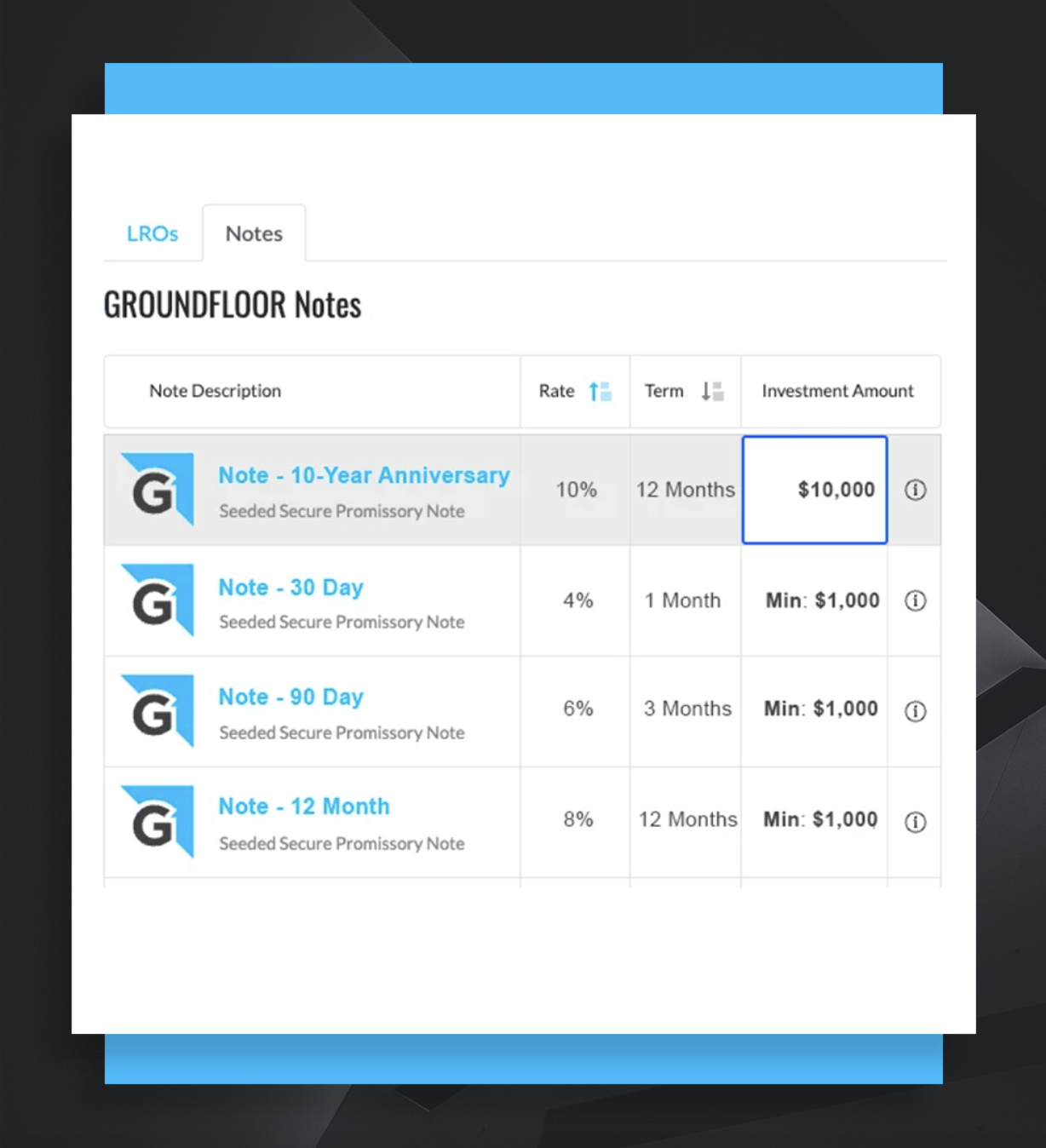
Screenshot of Groundfloor Notes

Benefits Of Investing In Groundfloor Notes

  • Passive income opportunity: Unlike physical real estate investing, which often requires a lot of hands-on effort, once you invest in Groundfloor Notes, your work is done, and you can enjoy receiving passive income.
  • Offers Diversification: When you invest in Groundfloor Notes, your money is secured by a real physical property, making it a great way to diversify a portfolio otherwise made up of stocks and bonds. 
  • Potential for High Returns: If you're willing to tolerate some risk, Groundfloor Notes give you the potential to earn much higher returns than keeping your cash in a checking or savings account.  

Who Shouldn’t Use Groundfloor?

Groundfloor isn’t an appropriate investment for someone who needs to high liquidity or a principal guarantee. If you need your cash to pay for school, buy a car or start your own business, don’t use Groundfloor.

Groundfloor also isn’t appropriate for an investor who has a low risk tolerance. Investing in Groundfloor doesn’t mean merely riding out volatility. It requires you to trust that marketplace lending is a good way for you to invest your hard-earned cash.

How Does Groundfloor Compare?

Groundfloor is not the only platform where you can invest in real estate related assets. However, they take a different approach by focusing on lending (versus owning an actual cash flowing property). That does give them some unique angles.

There closest competitor would be Peerstreet, which does require a much higher minimum of $1,000 to get started. There are also online platforms like Fundrise that allow you to invest in a pool of real estate.

See this quick comparison:

Header
Groundfloor Comparison
Fundrise
Peerstreet Review

Rating

AUM Fees

0%

1.00%

1.00%

Min Investment

$10

$500

$1,000

Open To Non-Accredited Investors?

Cell
OPEN ACCOUNT
READ THE REVIEW
READ THE REVIEW

Who Can Profit From Groundfloor?

If you’re willing to take on a bit more risk in exchange for somewhat higher returns, Groundfloor might be a great investment for you. Groundfloor could function like high-yield bonds in a well-diversified portfolio. It's not as liquid but the minimum to invest is just $10 per project!

Investors who don’t need immediate liquidity, and are willing to experiment, should look at Groundfloor LROs. It’s a passive way to get into the fix and flip action. This will appeal to a lot of investors.

The addition of Groundfloor Notes offers investors liquidity, with terms as short as 30-days, and more attractive interest rates than savings accounts and T-Bills. Keep in mind, however, that Notes are not FDIC-insured. 

Borrowers who can meet Groundfloor's rigorous standards will receive low-cost loans with terms that are favorable to flippers. The majority of Groundfloor's borrowers choose its deferred payment option, so they don’t have to make payments on the  loan during the course of the fix and flip project. As a borrower, this should be a source to consider.

Check out Groundfloor here >>

Groundfloor Review
  • Commissions and Fees
  • Ease of Use
  • Customer Service
  • Risk Mitigation And Due Diligence
  • Features
Overall
3.1

Summary

GroundFloor is a P2P real estate lending platform. As an investor, you can preview and fund loans for Fix and Flip properties. Potential borrowers submit a loan package that includes detailed numbers, pictures of the property and more. The GroundFloor team of experts reviews proposals, and then chooses to allow the loan into the pipeline or not.

Pros

  • Real estate lending platform that allows peer-to-peer real estate loans
  • Low minimum investment
  • Groundfloor Notes offer more liquidity and attractive short-term rates
  • Allows IRA investments

Cons

  • LRO’s are less liquid than other investments (terms of 6-12 months)
  • Some concerning user experience comments

  • Try Groundfloor
Robert Farrington
Robert Farrington

Robert Farrington is America’s Millennial Money Expert® and America’s Student Loan Debt Expert™, and the founder of The College Investor, a personal finance site dedicated to helping millennials escape student loan debt to start investing and building wealth for the future. You can learn more about him on the About Page or on his personal site RobertFarrington.com.

He regularly writes about investing, student loan debt, and general personal finance topics geared toward anyone wanting to earn more, get out of debt, and start building wealth for the future.

He has been quoted in major publications, including the New York Times, Wall Street Journal, Washington Post, ABC, NBC, Today, and more. He is also a regular contributor to Forbes.

Editor: Clint Proctor
If you want to invest in real estate without getting your hands dirty GroundFloor offers the perfect way to do so. Learn more in our GroundFloor review.
Editorial Disclaimer: Opinions expressed here are author’s alone, not those of any bank, credit card issuer, airlines or hotel chain, or other advertiser and have not been reviewed, approved or otherwise endorsed by any of these entities.
Comment Policy: We invite readers to respond with questions or comments. Comments may be held for moderation and are subject to approval. Comments are solely the opinions of their authors'. The responses in the comments below are not provided or commissioned by any advertiser. Responses have not been reviewed, approved or otherwise endorsed by any company. It is not anyone's responsibility to ensure all posts and/or questions are answered.
Subscribe
Connect with
I allow to create an account
When you login first time using a Social Login button, we collect your account public profile information shared by Social Login provider, based on your privacy settings. We also get your email address to automatically create an account for you in our website. Once your account is created, you'll be logged-in to this account.
DisagreeAgree
Notify of

I allow to create an account
When you login first time using a Social Login button, we collect your account public profile information shared by Social Login provider, based on your privacy settings. We also get your email address to automatically create an account for you in our website. Once your account is created, you'll be logged-in to this account.
DisagreeAgree

32 Comments
Oldest
Newest Most Voted
Inline Feedbacks
View all comments

Primary Sidebar

Robert Farrington will teach you how to get out of student loan debt and how to start investing.

Hi! My Name is

America's Millennial Money Expert

Welcome to The College Investor. We're here to help you escape student loan debt so you can start investing and building wealth for the future

Our expert guides, reviews, and more are designed to help you achieve your financial goals.

Want to learn more? See what's in my wallet.

As Featured In

Social Media

Popular Posts

Best Side Hustles

20 Best Side Hustles You Can Start Earning With In 2024

Passive Income Ideas

30 Passive Income Ideas For 2024 To Build Real Wealth

Net Worth of Millennials

Average Net Worth Of Millennials By Age

wait to repay your student loans

For-Profit College Student Loan Forgiveness List

Qualified 529 plan Expenses

What Are Qualified Expenses For A 529 Plan (And What Doesn’t Count)?

529 Plan By Age

How Much Should You Have In A 529 Plan By Age

Side Hustle Ideas

54 Side Hustle Ideas To Make Money Fast In 2024

Student Loan Forgiveness Programs

Student Loan Forgiveness Programs (The Complete List)

Most Expensive Colleges

20 Most Expensive Colleges In 2023

Ultimate Guides

Student Loan Forgiveness Programs By State

The Full List Of Student Loan Forgiveness Programs By State

529 Plan Guide

529 Plans: The Ultimate Guide To College Savings Plans

Student Loans and Financial Aid By State

Student Loan And Financial Aid Programs By State

Student Loan Advice

The Definitive Guide To Student Loan Debt

newretirement

How to Start Saving Now: The College Graduate’s Guide to Saving for Retirement

Latest Research

undermatching at selective colleges

Undermatching: Why Do Smart Low-Income Students Not Enroll In Selective Colleges?

Student Loan Borrowers Are Not Ready To Resume Payments

Survey: 55% Of Student Loan Borrowers Don’t Feel Ready To Resume Payments

How much to file taxes

Tax Survey: How Much People Paid To File And The No.1 Tax Software They Used

Inflation survey

Survey Shows 86% Stressed Over Money & Inflation (Side-Hustles To The Rescue!

students choose to work survey

Should I Work While In College? 75% Of Students Say “Yes”

Footer

Who We Are

The College Investor is an independent, advertising-supported financial media publisher, focusing on news, product reviews, and comparisons.

Connect

  • Contact Us
  • Advertise
  • Press & Media

About

  • About
  • Our Team
  • Podcast
  • Editorial Guidelines
  • How We Make Money
  • Archives

Social

Copyright © 2024 · The College Investor · Privacy Policy ·Terms of Service · DO NOT Sell My Personal Information

wpDiscuz